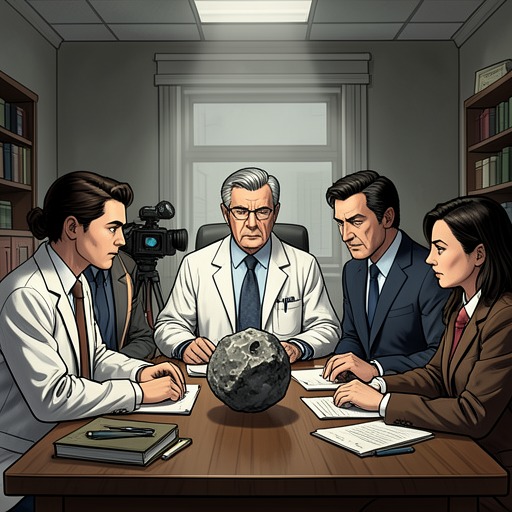
Testing aboard the Goya exposes the meteorite as a fake
Deception PointTesting aboard the Goya exposes the supposed Milne Ice Shelf meteorite as an ocean rock deliberately presented as a celestial discovery. The decisive turn comes through a chain of independent clues: a geological precedent from the Mariana Trench, a diagnostic chemical ratio measured in Xavia’s laboratory, and physical evidence that the object had been inserted through the ice. What NASA’s instruments had identified as a fossil-bearing meteorite is revealed instead as a manufactured story, with consequences reaching from the expedition to the White House.
From geological anomaly to testable question
The investigation aboard the Goya gains a crucial alternative explanation from the work of Lee Pollock, a young geologist at Drew University. The previous year, Pollock had used a marine robot to sample crust in the Mariana Trench and recovered a loose rock containing features resembling chondrules. He named these formations plagioclase stress inclusions: tiny metal bubbles that, in his account, could form when extreme deep-ocean pressure altered an existing rock and allowed its metals to fuse. His theory gave the expedition a terrestrial process capable of producing structures that might otherwise be taken as evidence of a meteorite.
The analogy was not enough by itself. Michael Tolland asked whether Pollock’s rock might instead have been an actual meteorite whose fusion crust had worn away during years underwater. Corky Marlinson pointed to nickel content as a way to assess that possibility. Pollock’s notes recorded a midrange nickel value unusual for terrestrial rocks but surprisingly close to the range associated with meteoritic material. That ambiguity made a more discriminating test necessary: resemblance and nickel content could not settle the rock’s origin.
Xavia’s notes supplied a sharper distinction. The titanium-to-zirconium ratio in the ocean sample’s chondrules showed ultradepleted zirconium, at only two parts per million. Corky emphasized the contrast: meteorites contain thousands of times that amount. Pollock therefore judged that his sample’s chondrules were not from space. The result did not automatically prove that the Milne specimen shared the same origin, but it identified a measurable feature that could separate deep-ocean inclusions from meteoritic chondrules. Tolland asked Xavia to examine a rock sample with an electron microprobe, whose accuracy he hoped would be sufficient to make that comparison.
The microprobe result
When the analysis was repeated, Xavia hurried back with the computer printout, visibly shaken. She told Tolland that the titanium-to-zirconium ratios in the sample showed NASA had made a major mistake: the supposed meteorite was an ocean rock. Her result converted the Pollock comparison from a theoretical possibility into direct evidence about the Milne specimen. The chemical signature that had raised questions in the Mariana Trench sample now appeared in the rock NASA had presented as extraterrestrial.
The result also recast details that had seemed to support NASA’s claim. Xavia wondered how an ocean rock could account for the fusion crust or the meteorite’s location in the ice. Tolland did not try to resolve those questions in the laboratory; he said the group would explain on the way to shore and that they were leaving. The exchange marks a shift from scientific hesitation to an urgent effort to preserve and carry the evidence. The chemical conclusion had become clear even though the means by which the rock had reached its position still required explanation.
Building the case from independent evidence
Rachel gathered the papers and records that together made the fraud, in Tolland’s and her judgment, conclusive. The GPR printout showed a shaft descending through the Milne Ice Shelf beneath the extraction pit, continuing down as a column of sea ice toward the open ocean. The image made the meteorite’s setting physically suspect: the shaft did not simply end at the object but extended through the shelf. That structural evidence complemented the chemical analysis rather than depending on it.
The dossier also included photographs of a living sea louse resembling the creature NASA had presented as a fossil, and Lee Pollock’s article describing ocean chondrules formed under deep-sea pressure. Alongside those materials, the microprobe data showed ultradepleted zirconium in the supposed meteorite. Each item addressed a different part of the claim: the GPR evidence concerned emplacement, the living animal challenged the fossil interpretation, Pollock’s research supplied a natural geological alternative, and the chemical measurements tested the rock itself. Rachel’s collected papers made the conclusion explicit: fraud. Tolland remarked that William Pickering now had his proof, while Rachel again wondered why Pickering had not answered his phone.
Political stakes of the discovery
The test aboard the Goya overturns more than NASA’s scientific announcement. In his later explanation, Pickering told Rachel that the information she had faxed from the ship was dangerous because it could make the White House and NASA appear complicit. He insisted that the President and NASA did not know the meteorite was false and believed it authentic. Pickering also distinguished their conduct from the deception surrounding the discovery: Lawrence Ekstrom’s role, as he described it, had been to persuade the PODS mission supervisor to lie about the anomaly-detection software, while the President and Ekstrom had not been brought into the larger scheme.
Pickering explained that the meteorite had been a desperate attempt to save NASA as Senator Sedgewick Sexton’s attacks threatened the agency’s future. After proposals to fold NASA into the intelligence community were rejected, Pickering and allied military powerbrokers sought to restore public and congressional support by reviving the grandeur associated with Apollo. The staged discovery was meant to capture the public imagination; its exposure threatened to produce the opposite effect, implicating the agency and administration in a spectacular deception. The Goya tests therefore serve as the evidentiary reversal at the heart of the crisis: a claim of alien life gives way to a provable terrestrial origin, and the scientific case becomes a political liability.
Narrative significance
The discovery is built not around one revelation but around correction across several kinds of evidence. A deep-ocean rock offers a plausible alternative to meteorite chondrules; a microprobe makes that alternative testable; the GPR image and photographs reinforce it through different means. The story’s decisive certainty arrives only when those strands converge. The test does not merely expose a mistaken interpretation: paired with the insertion shaft and the other collected evidence, it reveals that the meteorite’s apparent authenticity depended on concealing how it was made and placed.
That convergence also sharpens the distinction between institutional error and deliberate fraud. The PODS anomaly-detection software had failed, and the claim that the system had been repaired was itself a lie, but the Goya evidence establishes a separate and more consequential deception: the object presented as a meteorite was an ocean rock, while physical and biological clues had been arranged to support the false account. By carrying the printout and accompanying records toward shore, Rachel turns a laboratory result into evidence capable of challenging the public narrative. The scene’s outcome is therefore both scientific and political: the alien-fossil announcement cannot survive the accumulated tests, and Pickering’s attempt to protect NASA has become a danger to the President and the agency he meant to save.